Showing posts with label Lumen Fidei. Show all posts

Sunday, February 16, 2014

La Scelta, la Legge e la Perfezione Cristiana

6˚ domenica del tempo ordinario: 16 febbraio, 2014
La scelta è il tema centrale che attraversa le letture di oggi! E c'è un altro tema dominante che qualifica questa scelta - che è la legge o i commandamenti. Legge per il popolo di Israele era il modo di vivere ordinato dal Signore. La legge era per loro la garanzia di rimanere il popolo di Dio, era la loro parte di eseguire l'alleanza che il Signore fece con loro: io sarò il vostro Dio e voi sarete il mio popolo! Parlare o agire contro la legge era per loro una cosa grave e punibile. C'è una discussione su altri due temi - "perfezione" e "sapienza" nella seconda lettura. Intrecciando tutti questi, Gesù nel Vangelo ci presenta un atteggiamento perfetto e saggio verso la legge. Egli ci invita a una scelta personale, convincente ed impegnative.
La fede è una scelta ...
La fede non è un salto nel buio, si tratta di una scelta consapevole! Come afferma Lumen Fidei n.3, la fede non può essere associato con l'oscurità, invece la fede è una luce che illumina uno a scegliere, di scegliere di credere in Dio, di scegliere di vedere Dio vivo nella propria vita. La prima lettura d’oggi ci presenta la stessa prospettiva, abbiamo la scelta tra l’acqua e il fuoco, tra il bene e il male , tra la vera gioia ed i piaceri fugaci, tra il giusto e il conveniente, tra la convinzione ed il compromesso, tra la vita e la morte! La scelta è nostra! Non possiamo cavalcare sulle spalle di tradizione e costume, e giustificare le nostre azioni e le abitudini. Dobbiamo crescerci! La nostra maturità deve essere vista nella sapienza che possediamo . È Dio che ci dà questa saggezza, ci ricorda San Paolo. Gesù s’incarna la saggezza e presenta la stessa a noi nelle sue parole: non sono venuto ad abolire la legge, ma a portarla al suo compimento.

Una scelta al di là della legge ...
Gesù dichiara che i suoi discepoli dovrebbero fare una scelta non contro la legge, ma al di là della legge! Egli dà un nuovo significato alla legge, e presenta il modo di andare oltre, modo di trascendere un mero legalismo servile e raggiungere alla perfezione di santità, attraverso l'amore e la compassione. Le parole di Gesù: "Avete inteso che fu detto ... ma io vi dico", sentito più volte nel Vangelo di oggi ci presenta Gesù come il nuovo Mosè, e descrive la comunità dei discepoli come il nuovo popolo di Dio! «Ecco io faccio nuove tutte le cose», rivela Gesù ( Att. 21,5). La nuova legge... oggi come ci facciamo a capire la nuova legge, la legge oltre la legge. La nostra vita non comprende soltanto di evitare il male, ma è molto di più profondo e significativo. È di vivere, di amare, di relazionarsi, di fare il bene, di maturare, di essere felici, di rendere felici gli altri e cosi insieme come comunità di figli di Dio, di rinnovare il mondo e riempirlo di gioia.

Rispettare la legge ...
Gesù insegna le persone oggi non di andare contro la legge ma di capire che cosa significa veramente, rispettare la legge. Per Lui, di obbedire alla legge non era quello di obbedire alle parole della legge, ma di obbedire al Signore della legge! È stato così anche per il popolo di Israele, avessero obbedito alla legge come un atto di obbedienza a YHWH. Ma al questo punto quando il Signore della legge era con loro, loro non se ne rendono conto. La Parola ha vissuto e si è venuto in mezzo di loro, ma loro non l'hanno accolta. Il pericolo per noi è lo stesso: che possiamo essere per definizione il migliore dei cristiani - manca nessun giorno la Messa, regolare con la lettura della Bibbia e la recita delle preghiere, rigoroso con il nostro digiuni e l'astinenza, visitando molti santuari di pellegrinaggio possibile – ma dobbiamo stare attenti... ci può essere che perdiamo il punto centrale. Questi sono buoni ma non abbastanza non sufficienti- la Parola ci istruisce : Amare Dio e obbedirlo consiste... nel amare la Parola, e nel vivere secondo essa, non essendo soltanto ascoltatori della Parola, ma quelli che la mettono in pratica(Gia 1.22), per dire SI alla Parola significa essere pronti per affrontare tutte le conseguenze che c’è e vivere con entusiasmo nonostante di esse. Il nostro SI alla Parola deve essere la nostra scelta, la nostra scelta di andare oltre la legge e obbedire al Signore della legge , per vivere e riempire la terra con amore e compassione, per sfidare gli attuali standard del mondo verso creare un mondo nuovo, un cielo nuovo e una terra nuova! 

Saturday, February 15, 2014

OUR CHOICE: to Love and Abide by the Word

16th February,2014: 6th Sunday in Ordinary Time

Choice is the central theme running through the readings today! And there is another dominant theme that qualifies this choice - that is LAW. Law for the people of Israel was the way ordained by the Lord. Law was for them the guarantee of remaining  people of God; it was their part of executing the covenant that the Lord made with them: I shall be your God and you shall be my people! To speak or act against the law was for them a serious and punishable offence. There is a discussion on two other themes- "maturity" and "wisdom" in the second reading from St.Paul. Combining all these, Jesus in the Gospel presents to us a mature and wise attitude towards LAW. He invites us to Choose LAW... that is to choose to Live and Abide by the Word. 

Faith is a Choice...
Faith is not a blind leap, it is a conscious Choice! As Lumen Fidei n.3 affirms, faith cannot be associated with darkness, instead faith is a light that enlightens one to choose, to choose believe in God, to choose to see God alive in one's life. The first reading presents to us the same perspective today, we have the choice between water and fire, between good and evil, between true joy and fleeting pleasures, between the right and the convenient, between conviction and compromise, between life and death! The choice is ours! We cannot ride on the shoulders of tradition and custom, and justify our acts and habits. We have to grow up! Our maturity has to be seen in the wisdom we possess. It is God who gives us this wisdom, as St.Paul reminds us. Jesus embodies that wisdom and presents the same to us in his words: I have come not to abolish the law, but bring it to its fulfillment. 

A Choice beyond the Law...
Jesus declares that his disciples should make a choice not against the law but beyond the law! He gives a new meaning to law, and presents the way to go beyond, to transcend a mere slavish legalism and reach the heights of saintly perfection, through love and compassion. The words of Jesus, "You have heard that it was said,...but I say to you", heard repeatedly in the Gospel today presents Jesus as the New Moses, and describes the community of disciples as the New People of God! "See I am making all things new," declares Jesus by this (Rev. 21:5). The new law...today how do we understand that new law, the law beyond the law... L - to Love, A - to Abide, and W - the Word. To love the Word and Abide by it...is the new law that Jesus gives. The Word presents to us a guarantee to sanctity. To know the Word, to reflect on it and understand it, to love it and strive to abide by it, is the sure way to be real children of God, worthy people of God. Our life does not comprise merely of avoiding evil, it is much more profound and meaningful. It is to live, to love, to relate, to do good, to mature, to be happy, to make others happy and thus together as a community of God's children, to renew the world and fill it with joy.

To Obey the Law...
Jesus teaches the people today not to go against the law but to understand what it really means to obey the law. For Him, to obey the law was not to obey the word of the law but to obey the Lord of the law! It was so for the people of Israel; they obeyed the law as an act of obedience to YHWH. But when the Lord of the law was with them, and they did not realise it. The Word lived and moved among them, but they did not comprehend it. The danger for us too is the same: that we may be by definition the best of Christians - missing no Sunday Mass, regular with reading the Bible and reciting the prayers, strict with our fasting and abstinence, visiting as many pilgrim shrines as possible - but let us beware, we may be missing the point. These are good but not good enough - the Word instructs us: Love and Abide by the Word... to love the Word, and to live by it; not being merely hearers of the Word  but doers(Jam 1:22); to say YES to the Word and mean it, to face all the consequences of that Yes and live through it. Our YES to the Word has to be our choice, our choice to go beyond the Law and obey the Lord of the law, to live and fill the earth with love and compassion; to challenge the present standards of the world towards a new world, new heaven and new earth!


Sunday, February 9, 2014

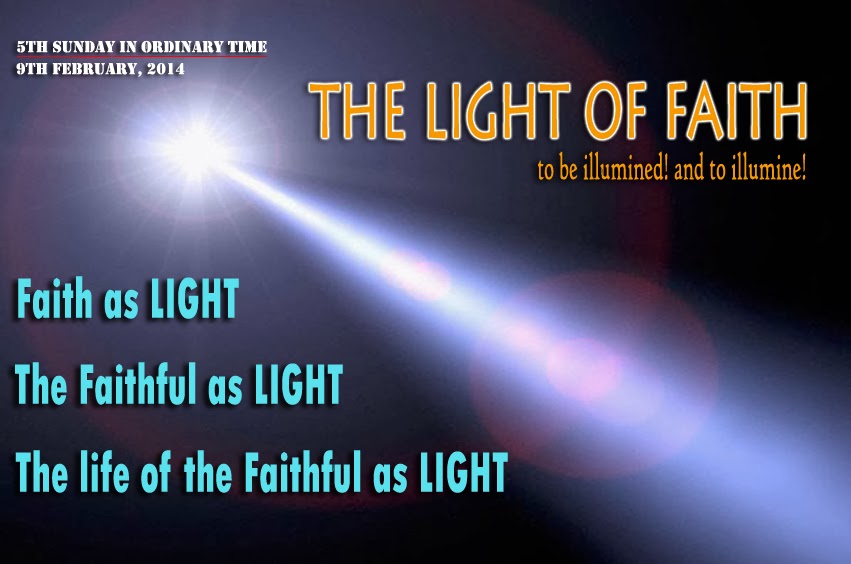
THE LIGHT OF FAITH

Be illumined! Illumine!

9th February, 2014: 5th Sunday in Ordinary Time

"The Light of Faith: this is how the Church's tradition speaks of the great gift brought by Jesus": so begins the encyclical Lumen Fidei. Light is an image very often presented in relation to faith, the faithful and the life of a faithful. It is an explicit call by the Lord right from the Old Testament times that the people of God have to be light to the nations (Is 42:6). With Christ's call today to be light of the world, it becomes an inevitable criterion to be identified as Christ's disciple or not!

Faith as Light: The first reading reminds me of a Zen story that I have heard of the Master who asked his disciples: When do you think it is dawn? The disciples attempted various responses, like - when we see the difference between a tree and a pillar; when we can identify a black thread from a white, and so on. The Master, discontent with everything, finally said: it is dawn, when you look into the eyes of the one next to you and see your brother or your sister! The first reading  tells us exactly that... when you accept the gift of faith from the Lord, your eyes are opened that you can see into the eyes of those around you and see your brothers and sisters; in their suffering and in their pains, you can feel your heart weeping and your eyes welling. We are reflecting today on the theme of LIGHT... the light that illumines us, the light that makes us see the real meaning of life and the true sense of being human. Which can do that task better than our faith - Faith is the Light we are offered by the Lord, as a gift! 

The Faithful as Light: Once we accept that gift, the gift of faith from the Lord, we as faithful, we become the Light! Receiving the light, we become the Light. The Lord sets us as the light to the nations, the light to the world, the light on the lampstand, the city on the hilltop! Our faith does not rest on human wisdom, or logical reason, or scientific thinking, or systematic and mind blowing theologies! Our faith is primarily founded on the power of God, reminds St. Paul in the second reading today. Illumined by the Light, we become the light! Jesus declared, "I am the light of the World" (Jn 8:12); but did not stop with that. He challenges us today, "You are the light of the World." Every person of faith is called to be a light that is set on the lampstand, to spread the light to the entire house, to illumine those around him or her. But it is important that we remember always that the source of our light, is the Light which illumines us all, the Light eternal of which we are rays, the eternal fire of which we are sparks.

The life of the faithful as Light: Being the light...what does that mean? It involves two important elements: One, everyone sees you; and two, one is able to see because of you! Just two days have passed after an exam that I gave, where the examiner asked me, what would be the apt mode of proclaiming the Good News to those who have not heard it. I said, "by living my everyday life!" One may ask, but where is the proclamation - I believe it is in the very living! Our life cannot have two shades - personal and public, sacred and profane, spiritual and secular... If I am a Christian - I should be seen! That is the first dimension of being light - my life has to be lived in its integrity. When the light can be seen, then one can see, because of the light. When my life can be seen by the other as a open book, the other can draw an inspiration to live by, and that is proclamation; that is evangelisation; that is illumining! It is through my life, my words, my actions and everyday choices that I become a light to the other; "if you bestow your bread on the hungry and satisfy the afflicted; then light shall rise for you in the darkness!" and thus one will become the light in darkness to the upright.

Let us keep this light burning in our hearts whole day today, to evaluate our daily life and see, if we really possess the Light of Faith, if we really live our life in a manner as to become light to those around me! Let the Eternal Light of Lord fill our hearts to be illumined and to illumine!

Thursday, January 30, 2014

WORD 2day: 30th January, 2014

Consecrated to Shine!

The tradition of consecrating oneself or consecrating one's family or consecrating the world to God, at some high moments of spiritual significance is no new practice! Right from Joshua who declared, "As for me and my household, we will serve the Lord" (Josh 24:15), we see this practice as an expressed desire to belong to the Lord despite changing times and diversified experiences. In fact, the Lord consecrated every one of us to Himself at our Baptism and this consecration has to be lived; it has to be pronounced with unction among the people; it has to shine forth reminding ourselves and inviting others to a fuller consecration to the Lord, our God. Have you consecrated yourself or your family to the Lord? If no, why not do it tomorrow... being Friday, you can consecrate yourself and your family to the Sacred Heart of Jesus and thus give the central place to the love of God in your family. There is a beautiful Catholic Tradition of Consecration of the family to the Sacred Heart of Jesus and an annual renewal of that consecration on a fixed date: could be a practical way to keep our faith alive and shining, like the lamp on the lampstand. 

Saturday, January 4, 2014

CELEBRATING THE SELF REVEALING GOD

5th January, 2014: The Feast of the Epiphany of the Lord

The only possibility of knowing about God is through God's own self revelation! God is no simple object to be discovered or invented; God is a person whom we should get to know. Knowing God is possible only through the self revelation of God in history, in the Word, in our day to day experiences and in ways known only to God. Today we celebrate that one event, that one life, that one person - JESUS CHRIST, THE SON OF GOD, in whom God revealed Godself fully, completely, definitively and super abundantly! The revelation has been going on even before Christ, through prophets and judges (Heb 1:1), through chosen men and women . The revelation goes on even today in our everyday life, through the Word and the traditions, through day to day experiences, through holy men and women who have gone before us and those of our times. These revelations find their fullness in the Paschal Mystery, that is: the birth, life, suffering, death and resurrection of Jesus, the Son of God.

The feast of epiphany is a celebration and a thanksgiving to the Self revealing God who deigned to reveal Godself in the person of Jesus Christ, our Saviour. This feast of revelation reminds of three realities of our faith:

SEEK... to know God: One has to seek, to know God; there should be a yearning within, in order to encounter God. The wise men from the east got wind of something special that was in store and they sought to know what it is. They were wise men, but they wanted to know more and more! Faith has to be deepened; there should be a yearning within us to grow more and more in our relationship with God. It is true that the fullness of revelation dwells in Christ, the Son of God...but I have to seek to personalise it, to encounter that revelation and relate to it in first person.

SEE... to find God: One has to see, to find God; God is always present with us, all that we need to do is see! 'Lift up your eyes round about, and see' says the first reading. We need to see the face of God: in our brothers and sisters; in those who are suffering and toiling; in those who are exploited and crushed; in those who are treated with disdain and burdened with pain; in those who wake up every morning not certain of the next; in those who have so many worries and concerns in life that they can never think of living the present moment! We need to see God, in the innocent love of a Child; in the tender touch of a mother; in the brimming eyes of a caring person; in the everyday miracles of life. Once we see God in these, we will surely find God concretely present in the Church, in the celebration of the sacraments and in our prayer moments. 

SHINE... to show God: One has to shine, to show God; we are called to become instruments of revelation ourselves. 'Arise! Shine!' calls the first reading. St. Paul speaks of how the Lord made him an instrument of revelation to the people! When we seek God and manage to see God, we begin to shine. That is why Isaiah says, "then you shall see and be radiant"...the very seeing makes us radiant, makes us shine! Our Faith is not merely to be understood and believed, but to be lived and be shared. Revelation is at one and the same time a grace and a challenge. A Grace, because it is gratuitous and comes from God. A challenge because, once we get to see God, we have to shine; shine and announce God; shine and share God; shine and show God to the world, to all who are in darkness, sadness and gloom!

The Self revealing God invites us to SEEK, SEE and SHINE. To accept the invitation is the act of FAITH; a beginning of a journey, a journey that lasts the whole life time- every day of which we are called to Seek the Lord, See the Lord and Shine for the Lord!

Tuesday, November 19, 2013

WORD 2day

19th November, 2013

Zacchaeus' episode in the Gospel is an evergreen example of an encounter that transforms a person. As St. Paul would say, 'if anyone is in Christ, there is a new creation'(2Cor 5:17). When we allow the Lord to really encounter us, the Lord transforms the whole person. Nothing remains the same, everything is new because we begin to see everything from the perspective of the Lord. As Pope Francis says in his recent encyclical Lumen Fidei, Faith is not just to see Jesus, it is to see with the eyes of Jesus (LF 18)! When our faith is authentic, the whole perspective changes. What seems to be important, what seems to be necessary for someone may seem totally secondary to me, because I see as the Lord does, because I think as the Lord does, because I love as the Lord does. Eleazar in the first reading demonstrates the same to us - 'such pretense is not worthy of our time of life' (2 Mac 6:24), he says, caring the least to preserve his life, because he did not want to lead the others astray from God. The primacy of God in our life defines the quality of our faith.

Sunday, October 6, 2013

GROWING IN FAITH

6th October, 2013 : 27th Sunday in the Ordinary Time


It is a familiar story said of the old lady who heard the gospel passage of today and challenged the young parish priest of its practicality! And they agreed she would pray for the tree outside her window to move a bit away after a novena. Nine prayerful days passed and on the 9th day asked the parish priest, 'so what about the tree?' The lady said with a wry smile, 'I knew from day one, nothing would happen! The tree stands right there.'

The Word of God this Sunday, invites us to grow in faith! "Increase our faith", pray the disciples. We would do good to make it our prayer too, asking the Lord to increase our faith. But what is faith? "Faith is the assurance of things hoped for, the conviction of things not seen" explains the epistle to the Hebrews(Heb 11:1). Where does this assurance and this conviction come from? From a relationship, a rapport on which our whole life is based and thus even things not seen and things hoped for, do not ever seem an impossibility. That is why our tradition defines faith as our personal response to a self-revealing God. Lumen Fidei the latest of the encyclicals states, faith is our response to the Word which engages us personally (n.8). 

Faith, being a relationship, is matter of daily experience and not just of extraordinary moments. It is easier for us, to look within ourselves and identify when this faith runs short, than to see it when it is there! Today's readings give us three indications of the lack of faith... in order to educate us towards growing in faith.

One of the familiar indications of lack of faith is Pessimism. The world today is flooded with pessimism - words like crisis, conflict, melt-down, inflation, decadence are most commonly heard terms on a daily basis. The first reading too presents a situation similar to today's -Violence, destruction, troubles, strife, contention -but it ends with that assurance: 'the righteous shall live by faith!' (Hab 2:4). Growing in faith is to fight against any pessimism creeping into our thoughts, our spirit and our outlook.

The second indication that the readings point to, is Panic. 'God did not give us a spirit of cowardice, but rather a spirit of power and of love and of self-discipline' (2 Tim 1:7). Where there is faith there will be power, if faith is a love relationship with God, there can be no fear, 'for there is no fear in love, but perfect love casts out fear' (1 Jn 4:18). When I begin to fear a situation or a person or a consequence, it is an indication that my faith needs nurturing.

The third indication is the reason for both the preceding ones. It is Pride. The perfect contrast to faith is human pride! If faith is surrender, pride inspires resistance. If faith is to relate, pride creates rebellion. If faith aids perseverance, pride instigates me to quit. Both pessimism and panic are in a way fruits of pride within. Humility is a fruit of faith; it is a realisation of who oneself is - a humble servant of God, with all the capabilities and limitations, working one's way towards building up the Reign of God here and now. It is Lumen Fidei again which beautifully states, 'Faith is God's gift, which calls for humility and courage to trust and to entrust' (n.14). 

Pessimism, Panic and Pride - are contrary to faith! Pessimism creates despair, panic destroys peace and pride makes me inhuman. May my prayer, 'Increase my faith' be accompanied by my personal efforts to trust, love and surrender myself unconditionally to the One who loves me so unconditionally! 


Saturday, August 10, 2013

COME HOME TO THE REIGN

11th August, 2013: 19th Sunday in the Ordinary Time


The theme of the last Sunday continues today, with a little further deepening. Reading and reflecting on the readings of today and their theme, I was reminded of the story of the Wizard of Oz by Frank Baum. I am sure most of us know the story or atleast have seen the film that was produced in 1939. Little Dorothy Gale finds herself blown away to a land far from home and yearns to return home. She gets to hear of the one who can help her get home…the great Wizard of Oz and she follows the yellow brick road that leads to the Wizard, in the hope of meeting the Wizard to find her way home! On the way, she enters into the lives of the Scarecrow who lacks brain, the Cowardly Lion who lacks courage and the Tin Man who lacks a heart…and changes their lives for the better as she finds her way home! How close this fable is to our lives, as presented by the readings today!

The people of Israel are on a journey, yearning to enter the Promised Land walking with hope in the path shown by the Lord, says the first reading. This Promised Land is not merely the land that is flowing with milk and honey – explains to us the letter to the Hebrews – we are bound to the city built by God, the city that the Lord has prepared for us. The final chapter of the recent encyclical Lumen Fidei, is inspired by this part of the epistle – “as it is, they desire a better country, that is, a heavenly one. God…has prepared for them a city” (11:16). This God’s city, it is much greater than a worldly city we can think of or the perfect society one can dream of – it is the Reign of God.

In the Gospel Jesus invites us with his wide open arms, “Come Home to the Reign!” And Jesus shows us the way, the way we need to walk towards this Reign. All the way to heaven, is heaven they say! Hence the way to reaching the Reign is creating it all along the way we walk through in life. How do we do it, we ask! And Jesus has a simple set of directions in the Gospel today!

The First of them, REALISATION of the true treasure. Following from the previous week’s reflection, Jesus calls us to a clarity on what is the real treasure! Selling everything and giving to the poor, providing oneself with the purses that do not grow old, earning treasures that are not eaten by moth – all these mean a right understanding of what a true treasure is, so that our hearts may be sufficiently prepared and firmly set towards it. Abraham knew it and that is why he was prepared to give up even his only, beloved son! Abraham realized that God’s promises were much more dependable than all that one can possess!

The second is READINESS to receive the Reign from the Lord’s hands! Prompt to pick up the signs and challenges of the Reign of God, we are challenged to respond to the demands of the Reign at any time. It could be at home in the family, on the streets in the neighbourhood, at work in the workplace, amidst those who do not know Christ, in contact with those who do not believe in God, in the face of an injustice, in the wake of a conflict, in the presence of someone who is going through a crisis – wherever we may find ourselves, we are called to be people of the Reign. Reign of God is not merely a destination we are bound to, it is a situation we are called to create together as a family of brothers and sisters called by one God, our father and mother!

The third is RESPONSIBILITY towards brothers and sisters, to serve those around as the least of all, without counting the cost or expecting a return. Forgiveness, Compassion, Love and Service are concrete expressions of this responsibility. Being of service to the needy, being sources of consolation to the suffering, being the voice of the voiceless, embracing in charity everyone even those who hate us – these are the signs of the Reign and the ways of making present the Reign even as we journey towards the fullness of its presence! We cannot think of a moment opportune or inopportune for these… as disciples of Christ we are called to this responsibility 24/7 and every one of the 365 days! It is tiring and demanding – Yes! From the one who has been given much, much will be expected! There is no alternative! Let’s not be lost on our way to the Reign!


If we have to get home to the Reign…we have to realize what a treasure the Reign of God is, be ready to accept it at any point of time and carryout our responsibility on a daily basis – our responsibilities of love, testimony and service to our  brothers and sisters. Let’s walk dear brothers and sisters, in the way of Christ – let’s walk our way to heaven, let’s get home to the Reign!

Thursday, July 25, 2013

WORD 2day

26th July, 2013: Sts. Joachim and Anne, parents of Mary: Grandparents' Day!!!

The first setting in which faith enlightens humanity is the family, declares the recent encyclical Lumen Fidei (52). It further explains that passing of faith in the family happens in the process of shared expression of faith within the family, helping children to become aware of their faith and grow and mature in it. Christian faith is always communitarian and it is passed primarily in the family. Recently someone observed to me, sharing on the level of faith being lived (or practiced) in Europe vis-a-vis in India, that one major reason for the degeneration in Europe is the weakening of the institution of the family. Those who hand on faith to us are really God-given. Most important among them, our parents and grandparents who not only give us life but show us also how to live it, from their own experience. Celebrating a day to remember the parents of Mary, the Mother of God and our Mother, provides us an opportunity to remember with thanks these our fore-runners in faith, as the first reading suggests, 'let us praise famous persons, our parents in their generations. These were persons of mercy, whose righteous deeds have not been forgotten' (Sir  44:1,10). Infact, thanks to them, we are in a position better than them due to their hard work, great example and their dreams for us! Jesus acknowledges that in his words (Mt 13:16-17) and exhorts us to live up to our blessedness, our giftedness, worthy of the faith and tradition that is transmitted to us, from our predecessors. Maybe, a grateful remembrance of our grandparents if they are no more, or a bear hug to them if they are still with us, will be in place today! 

Sunday, July 14, 2013

LUMEN FIDEI - VII

Blessed is she who believed

Concluding Section (Art. 58-60) and some Personal Remarks...


As a concluding note the encyclical presents to us a model or an exemplification of all that has been spoken about. And in right words it says, "the Mother of the Lord is the perfect icon of faith" and quotes the words of St. Elisabeth in the Gospel according to St. Luke (1:45), 'Blessed is she who believed'. Calling the Blessed Mother, "good soil", the encyclical calls to our attention the meaningful expression of Justin Martyr, 'In receiving the message of the angel, Mary conceived faith and joy'(58). Mary can be pictured as someone who closely followed Jesus in his entire salvation journey right from the moment of the Word becoming flesh to the moment when this son of hers was raised to the right hand of the Father as the eternal Lord and sovereign judge (59). 

The last article(60) is a beautiful prayer made on behalf of us all, to the Blessed Virgin ...

to Sow in our faith the joy of the Risen one,... 
to Remind us that those who believe are never alone,... and
to Teach us to see all things with the eyes of Jesus.

Personally...

The experience of reading through and reflecting on this Encyclical has borne one remarkable fruit in me - not to look at faith as something that is just between me and my God. It is definitely much more than that, it is something that defines my day to day life, my every relationship, my decisions on even the most ordinary things, my priorities - in short the entire world in which I live. I cannot think of my faith as something that is apart from me, for it has become the very personality that I am, from the very moment that I accepted it in my baptism and confirmed it through other sacraments of initiation. It is a gratuitous gift that God has placed within me, in the core of my being and it affects every aspect of my life. It makes me go out of myself and find myself in solidarity with the brothers and sisters in the same Lord to whom all of us respond in our own way, influenced by our personal traits and social upbringing. The very understanding of the institution of the Church as the communion of persons united in one expression of faith, is something that can facilitate readily our journey towards making present the Reign of God on earth.

However, there is one point on which the encyclical gives away a necessity of growth within the Church and the Official Magisterium of the Church. It is the aspect of Inclusive Language. The encyclical, or the least to say its English translation, still has a language that is highly masculine. Except in three places (art. 21,26,45), everywhere else the reference to a Christian or to the person to whom the encyclical is addressed, remains masculine - that is "he" or "him" or "man"! If the Magisterium can learn from the evolving times and the growing sensitivity, and become more inclusive in its language, it would be a more Reign-likely picture of the Church that it can offer to the world. 

If at all there is something that can be felt as a lack, it could be pointed out that the practical application of faith and the pastoral challenges it poses could have been treated a little more elaborately. Though the fourth chapter undertakes the task, personally at the end of the chapter, I could not help feeling disappointed that some current issues and urgent problems have not been touched upon. The feeling notwithstanding, the encyclical given its nature cannot speak of everything and within its scope, it appears quite complete!

Being the first one of the Pontificate of Pope Francis, LUMEN FIDEI has set the tone to the pastoral-minded Pontiff's wish for the flock that he shepherds. He has thrown a candid invitation to the faithful, to live their faith than just to possess it. Living the faith brings one's religious convictions to the daily life, and to the events and persons that fill it, and requires one to converse, dialogue and relate with the other, thus building relationships that lead each and every one to do one's part towards building the Reign of God, here and now!

The End... A personal summary by... Antony Christy sdb. 


Saturday, July 13, 2013

BE LOVE! BE COMPASSION!

14th July, 2013: 15th Sunday in Ordinary Time


Religion has been traditionally considered a search for God, some of them are long-winded and some others super-human. The Liturgy today differs from this point of view and indicates to a Christian that living as a Christian is neither too hard nor too far off. Jesus Christ the Son of God has brought it so close to us, by becoming one of us and having lived out for us in his own life a model to be emulated, an example to be followed and a path to be retraced. Those who wish to take the unbeaten path need not worry, for this path traced by Jesus will forever remain unbeaten for not as many as enough dare take that path. The Challenge thus is alive for you and me today!

The Word of God is in my heart! What God wants of me, what really matters to lead a life worthy of the One who created me, is right within me! It is in the core of my being, because I am created in the image and the likeness of God (Gen 1:27) and having been created in God's own image, I have within me all that is Godly...all that is characteristic of God, I have it embedded in the core of my being! If nothing hinders or distorts it, this is what I will manifest too in my daily life! This is what the book of Deuteronomy teaches us today in the first reading! The latest encyclical Lumen Fidei (LF 20) makes reference to this passage and speaks of the exegesis made by St. Paul on this passage from Deuteronomy - in Romans 10:6-7 we read St.Paul telling us, that we need not wonder how will we come to understand this inherent nature of ours - because we have Jesus Christ who has revealed it to us!

Christ came to reveal to us not merely who God was, but who we were; that we are the image and likenesses of God, that we are sons and daughters of a God who is love and compassion. A literal translation of the Hebrew version of Psalm 103, would read, "The Lord is compassion and love" (Ps 102(103):8) - not merely that God is compassionate and loving, but God is compassion and love! Christ was the visible image of this invisible God - Christ was the love of God personified, Christ was the living image of Compassion. He came to reveal to us, how much God loved us and how filled with compassion God is. Our call to be Christians is not a call to believe in some truths and adhere to some moral virtues, it is to live as Christ lived, to think as Christ thought, to feel as Christ felt, to love as Christ loved!

That is why Jesus did not stop with the two great commandments, he made them just one and said - "I give you a new commandment, that you love one another. Just as I have loved you, you also should love one another" (Jn 13:34). According to Christ it is not enough to love the other as I love myself... but I am called to love the other as God loves me, as Christ loved me - that is, to love unconditionally, to love without counting the cost, to love even upto the death on the Cross!

That is a challenge! That is why when they asked Jesus who is my neighbour, Jesus did not answer them directly. He gave them a parable and made them reflect, to whom they have to be a neighbour! Yes the Lord invites me today to be a neighbour to every person who is in need, every person who is suffering alone, who is left to bleed on the pavements of the present world of globalisation, consumerism and technological domination. I am asked to be a neighbour to everyone who is tired and heavy laden, everyone who is lonely and sick, sick in the body, mind, heart and soul. Let me not ask anymore the stale question, who is my neighbour! If I am truly a Christian, I would ask a question more pertinent - TO WHOM SHOULD I BE A NEIGHBOUR...and the answer will be right before our eyes.

And the way to be a neighbour is what Jesus explains today! To be like himself, to feel for the other like Jesus, to live like Jesus, to love like Jesus - that is to BE LOVE, to BE COMPASSION in the world today. That is the most fitting way to be a Christian today.

Friday, July 12, 2013

LUMEN FIDEI - VI

God prepares a city for them

Chapter 4: Articles 50-57.


Faith is not merely a journey alone, affirms repeatedly the encyclical, it is also a process of building, building a city, a society, a place where humanity can live together. As Noah the first builder in faith built the Ark, and Abraham set up tents, we are called to build the world in to a place habitable for humanity today. As we see in those persons of faith, firmness of faith marks the city which God is preparing for humankind. Faith is born of an encounter with God's own love and hence it does not speak of an interior firmness or steadfast conviction of the individual alone; it illumines every human relationships (50). The light of faith enhances the "richness of human relations, their ability to endure, to be trustworthy, to enrich our life together"(51). Anything other than love, if it becomes the basis of human unity, it involves calculations of utility! Hence a the light of faith is at the service of justice, law and peace, as a way of creating enduring and enriching human relations. The Old Testament for example, presents to us persons like Samuel and David, whose faith enabled them to "administer justice"(51).

The Old Testament bears witness to the fact that blessings were passed from fathers to the sons, establishing for us, that "the first setting in which faith enlightens the human city is the family"(52). Marriage and the origin of New Life, are direct interventions of God's love. "Promising love for ever is possible when we perceive a plan bigger than our own ideas and undertakings, a plan which sustains us and enables us to surrender our future entirely to the one we love"(52). Passing on Faith in the family happens in the process of shared expression of faith within the family, helping children to become aware of their faith and grow and mature in it. The Young people need the closeness of the family and the Church, as they find themselves in the troublesome yet rich phase of their life(53). The encyclical recalls the experiences of the World Youth Days and finds in them but a manifestation of the yearning of the Young, to live their life to the fullest. "Encountering Christ, letting themselves be caught up in and guided by his love, enlarges the horizons of existence, gives it a firm hope which will not disappoint"(53). "Faith is no refuge for fainthearted, but something which enhances our lives" (53) declares the encyclical.

Faith, in concrete a situation, becomes the light for the life in the society. It invites one to look at the other as a blessing, as someone through whose face the light of God's love shines. A human person is not cast adrift in the nature of the world; he or she can never renounce one's proper moral responsibility nor can presume "to be a sort of absolute judge endowed with an unlimited power to manipulate the world around him"(54) or her.  Revealing the love of God the creator, faith enables us to respect nature and discern in it a "grammar written by the hand of God and a dwelling place entrusted to our protection and care"(55). A concrete expression of faith requires that we are responsible for 'just forms of governance' which believes that authority comes from God, at the service of the common good; for 'possibility of forgiveness' which requires time, effort, patience and commitment. "Rather than avoiding conflict, we need to confront it in an effort to resolve and move beyond it, to make it a link in a chain, as part of a progress towards unity"(55).

Faith as the source of consolation and strength amid suffering, sheds a special light on personal lives of those who suffer and on suffering as a human reality. "Christians know that suffering cannot be eliminated, yet it can have meaning and become an act of love and entrustment into the hands of God who does not abandon us; in this way it can serve as a moment of growth in faith and love." "Even death is illumined and can be experienced as the ultimate call to faith, the ultimate "Go forth from your land"(Gen 1:12)" (56). Persons who suffer have been sometimes extraordinary mediators of light, as Francis of Assisi saw his light of faith from a person with leprosy and Mother Teresa found her light from the poor and dying.(57) "Faith is not a light that scatters all our darkness, but a lamp which guides our steps in the night and suffices for the journey" says the encyclical bringing out the aspects of the accompanying presence of God with us and the ray of hope that faith offers at the service of common good. We can hear the voice of Pope Francis distinctly when we read those lines which address us saying, "Let us refuse to be robbed of hope, or to allow our hope be dimmed by facile answers and solutions which block our progress" (57).

Ending with the note of hope the encyclical earns itself the image of a beacon that guides a Christian today, in his or her life of faith, to walk one's journey with courage and optimism amidst the shadows that befall the times. (to be continued...)


Thursday, July 11, 2013

LUMEN FIDEI - V

I delivered to you what I also received

Chapter 3: Article 37 - 49.


The Chapter invites us to understand the need for handing on faith from one to the other and underlines the element of a shared faith, picturing to us the role and the function of the Church, as the Mother of our faith. Infact, that is the subtitle of the section that begins this chapter saying, "since faith is hearing and seeing, it is also handed on as word and light"(37). A simple but profound image is given to us to understand this fact, from the Easter Liturgy where hundreds of small candles are lit from the One Paschal Candle, and the light is passed on from one candle to the other! Because faith is born of an encounter which takes place in history and lights up our journey through time, it must be passed on in every age(38), states the encyclical. Passing on is such an important element in our human life, for our knowledge and self awareness itself is linked to the others who have gone before us, to begin with those in the prime place - our parents! In the same way, when it comes to our faith, it is the Church, the mother, who teaches us to speak the language of faith (38). This relationship between faith and Church can be understood from various terms, such as Tradition, Shared experience, handing on, communication etc.

Those who believe are never alone; faith is always shared and it tends to be spread; it invites others to share in its joy (39). "Faith needs a setting in which it can be witnessed to and communicated, a means which is suitable and proportionate to what is communicated"(40). Faith and memory are related and the Church like a family passes on the store of memories! Of the means that the Church has to play this function, the first and foremost is, Tradition, which comprises of "everything that serves to make the people of God live their lives in holiness and increase their faith" (40). 

Another prominent means is the Sacraments which are special means of passing on faith - they communicate "incarnate memory, linked to the times and places of our lives, linked to all our senses"(40). Baptism, gives new context and a new environment and through them a new life. One cannot give baptism to oneself, it is something received. The communal nature of Baptism is brought out in the elements like the Trinity, in whose name baptism is carried out - the filial identity granted by God, who is a communion; the Water, which at one and the same time symbolises death and the eventual rise to new life. It epitomises the womb from where one is born to new life (41-42). Baptism is a rebirth that gives one a new life, a new name. It is important that we see the significance of the infant baptism here, for "faith is a reality lived within the community of the church; part of a common 'We'"(43).

The Sacramental character of faith finds its highest expression in the Eucharist. Eucharist is a precious nourishment for faith: an encounter with Christ truly present in the supreme act of his love, the self-giving gift of himself (44). There are two dimensions of faith that we can find intersecting in the Sacrament of the Eucharist - One, the dimension of history - as an act of remembrance, making present the mystery of the past; second, the dimension of being led from the visible world to the invisible world! (44) The Celebration of the Sacraments bring together, faith and memory! For a specific instance, the Creed that is professed with its Trinitarian Structure, the Christological Confession and the Fellowship Factor, brings into picture the collective memory that signifies a "new life of faith as a journey of Communion with the living God"(45). 

Faith, Prayer and Decalogue is the following section that highlights the other shared elements of our communitarian faith - The Lord's Prayer, which is a way of sharing Christ's own Spiritual experience and the Decalogue, which gives "concrete directions for emerging from the desert of the selfish and self enclosed ego in order to enter into dialogue with God, to be embraced by his mercy and to bring that mercy to others" (46). Thus, the profession of faith, the celebration of the sacraments, the path of the ten commandments and prayer - are the 4 elements of the memory that the Church hands down; notice here that these are the very four traditional formats in which the Catechism of the Catholic Church proceeds (46).  

The final point that the section makes is about the Unity and Integrity of Faith - as expressed by the words of Paul in Eph 4:4-5- one faith, one body, one spirit, one baptism, one Lord! The society today rules any acceptance of one truth, as a breach of freedom of expression or autonomy of the self, while paradoxically it is ready to unite for one cause or one issue! Disregarding this bias, the Church affirms that Faith is one, because of the oneness of God, the One Lord Jesus, and the one body and one spirit which shares that faith (47). Since Faith is one, it has to be professed in all its purity and integrity (48); choosing some aspects and leaving out some is no Faith! Apostolic Succession (49), which is the gift of Christ to the Church, guarantees this oneness of faith and the integrity of truth.

In short the Chapter brings out the fact of the Church as the subject who has and expresses the faith, as a response to the self-revealing God who has changed the lives of the persons forming part of it, called them and constituted them into one body, one spirit, in the one Lord Jesus Christ.  

The question that remains to be treated is, what would be the practical import of this faith in the concrete life in today's world. The next chapter would begin to analyse this question (to be continued...).


Wednesday, July 10, 2013

LUMEN FIDEI - IV

Unless you believe, you will not understand

Chapter 2 : Articles 23 - 36.

The subject matter gets denser here! But let's not lose heart or despair... proceed reading and absorb the crux of the second chapter.

The first section of the chapter, Faith and Truth, begins with a reflection on an incident in the life of King Ahaz who decides to seek the security of the support or protection of the great Assyrian empire and Prophet Isaiah warns him not to. The Prophet directs the king to trust only in God, the rock of Israel. The prophet challenges the king to understand the Lord's ways and to see in God's plan the faithfulness of God (23). The lesson for us: "we need knowledge, we need truth, because without these we cannot stand firm, we cannot move forward" (24). Faith without truth becomes a mere sentiment. 

Today truth is either absolutised to convenient concepts by Pragmatism, Scientism, Technologism and their sorts or reduced to subjectivity by Relativism. Consequently, the ultimate truth that is sought or the Question of God becomes IRRELEVANT, leading thus to fanaticism (25). Faith shows the right way of understanding truth. As St. Paul asserts in Rom 10:10, one believes with the heart. It is at the meeting point of faith and the heart(love) that true knowledge is born. "Faith's understanding is born when we receive the immense love of God which transforms us inwardly and enables us to see reality with new eyes" (26). Speaking of love in relation to faith requires that we do not lose sight of the fact that love can never be reduced to a mere ephemeral emotion. Only to the extent that love is grounded in truth can it endure over time, can it transcend the passing moment and be sufficiently solid to sustain a shared journey of persons. In short, love and truth are inseparable (27). It is in appreciation of the love that God had for them, that the people of Israel understood the overall unity of the divine plan (28).

Faith as hearing and sight, is the following section that takes the discussion further into the realms of philosophy. It begins with St. Paul's logic that Faith comes from hearing (Rom 10:17) and that the freedom to hear, acknowledge and respond to the voice is expressed in 'obedience of faith'(Rom 1:5). While the Greek categories would contrast hearing and seeing, the Old Testament Biblical categories combine them! Hearing God's voice is accompanied by a desire to see God's face(29). In the New Testament, Gospel of John brings these together in a beautiful synthesis stating that, to believe is to both hear and see - recognising the voice of the Good Shepherd (10:3-5) and seeing what God does and believing in God (11:45); for John believing is to see (11:40) and to see is on order to believe (20:8). The finest synthesis between hearing and seeing, is achieved in the faith in Christ, the word made flesh (1:14)- the spoken word that gets to be seen and believed!(30) The encyclical quotes Augustine to bring the synthesis to the next level that to believe involves also, touch. St. Augustine's words: "to touch him with our hearts: that is what it means to believe"(31).

The Dialogue between Faith and Reason, has been initiated right in the beginning at the moment of the historical encounter of the Gospel message with the Greek philosophical culture of the ancient world (32). The light and the word, as two beckoning forces that summons response from a person in his or her freedom - the former is related to seeing and the latter to hearing. St. Augustine in his earlier philosophical mindset gave importance to seeing whereas in the later he came to understand the truth that these both are to be taken together and he speaks of "word which shines forth within" (33). Philosophically, truth does not lie in subjectivity nor in totalitarianism, but in the point where one realises that truth humbles, that it sets one on a journey, that it enables witness and dialogue (34).

Faith and search for God, are related to each other especially when we acknowledge the fact that our God, is a "God of perpetual surprises"(35). "The more Christians immerse themselves in the circle of Christ's light, the more capable they become of understanding and accompanying the path of every man and woman towards God" (35). Hence dialogue with other religions is enabled by the very light of faith in Jesus and arises from the conviction that God who is light can be found by anyone "who seeks him with a sincere heart"(35).

Faith and Theology, are intrinsically related. Christian theology is born of the desire to explore more and more the horizons illumined by the light of faith. Theology, at one and the same time, is at the service of faith and draws life from faith. It is at the service of faith in as much as it protects and deepens the faith of the ordinary persons and it draws life from faith when it presents the Magisterium, as the source and collective expression of our faith. 

Looking at faith from various standpoints and providing an enlarged picture from where to understand our faith and its fundamental relationship to every other facet of Christian life, the encyclical would proceed in the next chapter to present to us the important truth that faith is not only to be understood; it is to be proclaimed. (to be contd...)


Monday, July 8, 2013

LUMEN FIDEI - III

We have believed in Love

Chapter 1: Articles 8-22

Having established in the introductory note, that this is "a time when mankind is particularly in need of light" (4), in the first chapter the encyclical draws on history to paint the canvas of a holistic understanding of Faith. Beginning from Abraham, the father in faith (8-11), the focus traverses right up to the Church which serves as 'the one body in faith'(21), journeying through the experiences of Israel, the people of God in faith (12-13), those of Moses, the mediator of God in faith (14-15) and the life, death and resurrection of Jesus, the Son in whom we are made sons and daughters of the God who has loved us, called us and chosen us from eternity.

Presenting Abraham, the encyclical highlights from his experience that faith is "our response to a word which engages us personally" with a God, who is a God of persons (God of Abraham, God of Isaac and God of Jacob) (8); a word which is at the same time a call and a promise (8) - a call to be faithful and a promise of the faithfulness of God (9). The words of St. Augustine is recalled fittingly here, "Man is faithful when he believes in God and his promises; God is faithful when he grants to man what he has promised." The man of faith gains strength by putting himself in the hands of the God who is faithful, explains the letter. 

God's light shines for Israel through the remembrance of the Lord's mighty deeds, recalled and celebrated in prayer and worship, and passed down from parents to children (12). Israel as congregation of faith, were akin to us in their weaknesses in the face of the temptation of unbelief, defined in the word, IDOLATRY. It was after all their incapacity to bear the mystery of God's hiddenness (13). And as then, even today the way out of idolatry is true faith that "turns to the living God in a personal encounter" (13).

Moses is brought in as the icon of the meeting point of the communitarian aspect of faith and the personal commitment to faith. "The individual act of faith finds its place within a community, within the common 'we' of the people," affirms the encyclical (14). From Moses,the mediator who enabled people have a vision of God, through the eyes of faith, the encyclical makes a shift to Jesus the ultimate mediator, the one who makes known God to us, as John explains in his prologue.

Jesus, specially in his death, portrays the ultimate light of faith. The world may look at the death on the Cross as a scandal of faith, but "it is precisely in contemplating Jesus' death that faith grows stronger and receives a dazzling light," revealing to us a love that is capable of embracing death to bring us salvation (16), a love that can be encountered, a love fully revealed in Christ's passion, death and resurrection (17).

Today, for us therefore, "faith does not merely gaze at Jesus, but sees things as Jesus himself sees them, with his own eyes: it is participation in his way of seeing" (18).  There can be three shades of believing that form a complete expression of faith in Jesus - Believing that (that what Jesus tells us is true), Believing (accepting Jesus' words and testimony because he is truthful) and Believing in (that is allowing Jesus into our personal lives, moving closer to him, clinging to him and following him all the way) (18). 

It is the Spirit that inspires us to make this move of faith towards Jesus and call him "Lord"; it is the Spirit that enables us to accept Christ's experience and call God, "Abba Father". Faith is a gift, a free gift of God, in the Spirit, who makes is children of God, in Christ Jesus (19-21).

Faith is necessarily ecclesial; it is not a private matter or a completely individualistic notion or a personal opinion (22). As Abraham "heard" God and obeyed him in faith, our faith too comes from hearing and it is meant to be expressed in words to be heard and proclaimed, says the encyclical at the end of the first chapter.

Some wonderful affirmations of this section on what faith is, inspired by the history of salvation, are worth being recounted here: 
- Faith opens the way before us and accompanies our steps through time. (8)
- Faith is our response to a word which engages us personally. (8)
- Faith is the capacity to bear the mystery of God's hiddenness. (13)
- Faith is God's free gift, which calls for humility and courage to trust and to entrust. (14)
- Faith is participation in Jesus's way of seeing the reality. (18)
- Faith in Christ, is the light that illumines the origin and the end of life. (20)

With this framework of understanding faith, the following section will proceed to comprehend the depths of faith in relation to various other frameworks of understanding. (to be contd.)


Sunday, July 7, 2013

LUMEN FIDEI - II

Part 1: The Introduction or Prelude (1-7)

The first section is not sub-titled but the purpose is very simple, a presentation of the encyclical's situation, background and the context that necessitates the theme.

Pope Francis explicitly places on record with gratitude the contribution of Benedict XVI in the encyclical and says that he has merely added his contribution to the "fine first draft" prepared and handed on by his predecessor(7). And he underlines the occasion that serves as the backdrop of the encyclical - the year of faith proclaimed, again, by his predecessor to commemorate the 50th year of the initiation of the great Vatican Council II, which he calls rightly, "Council of Faith" (6). 

The term 'light' in the theme 'Light of Faith' does not serve an aesthetic end, but it brings out essentially the quality of faith that the Church wants at this juncture to underscore - the illumining nature of faith! The Modernity has found this light childish and only for the weak and the ignorant. It is here Nietzsche is quoted as skeptically suggesting to his sister, "if you want peace of soul and happiness, then believe, but if you want to be a follower of truth, then seek" (2). It is as if to suggest that faith and seeking are two opposed dimensions of human knowing. And as a result of this, "humanity renounced the search for a great light, Truth itself, in order to be content with smaller lights which illumine the fleeting moment yet prove incapable of showing the way" (3). This is the context within which the light of faith is presented by the Church as a guiding beacon. 

The teaching founds itself on the conviction that "once the flame of faith dies out, all other lights begin to dim" (4) and declares that "faith is born of an encounter with the living God who calls us and reveals his love, a love which precedes us and upon which we can lean for security and for building our lives" (4). Faith is a light, both from the past and from the future. From the past, because it is inspired by the foundational memory of the life and death of Jesus Christ. From the future, because Christ has risen and he draws us to life, to life eternal (4).

Presenting these as the fundamental premises for us to position ourselves, the encyclical proceeds to bask in the light of faith, from the past and from the future. (to be contd.)

Saturday, July 6, 2013

LUMEN FIDEI - I

Part 0: My Initial Feelings...

We are in wonderful times! That was my initial feeling as I saw today (5th July, 2013) the Holy Father Pope Francis, accompanied by the Pope Emeritus Benedict XVI, stand on the lawns of the Vatican Gardens and address the media, presenting the first encyclical of his Pontificate! As "brothers in faith" - that is how Pope Francis refers to himself and his predecessor - they stood there witnessing to the real concept of service of authority, within the portals of the Church.

Lumen Fidei (The Light of Faith) comes to complete the Trilogy begun by the former Holy Father Pope Benedict XVI. Of his three encyclicals, two were reflections on the  Cardinal Christian Virtues of Love and Hope. The present encyclical comes to complete the reflection, offering to dwell on the virtue of Faith. Deus Caritas Est, published in 2005, on Christian Love and Spe Salvi, published in 2007, on Christian Hope, are the two of the Encyclicals which have been complemented with the present one signed by Pope Francis on 29th June, 2013, the feast of Sts. Peter and Paul. The significance of the feast of the two saints and the encyclical being written by two - one signed and one unsigned- authors, seem to be more than a coincidence.

My another feeling of "Wonderful Times" came from the fact that I was able to read the encyclical the very day that it was presented by the Holy Father to the World - thanks to the advancement of the Social Media and the presence of the Church in the world of Media. Beginning with this note, I intend to post here, my first glance of the encyclical. I wonder how far a theological reflection it could be, however I don't wish to claim that this would be so! All that I propose to do is present a personal initial summary on the Encyclical in parts, deferring a theological reflection for another moment. 

There are certain 'firsts' that mark this encylical and its context, a list of that can be interesting.
- obviously, it is the first time an encyclical has been written by two persons! Pope Francis and Pope Emeritus Benedict XVI. However, it is signed by only one - for we have One Pope and there is no confusion about it.
- for the first time, a Pope and his predecessor present an encyclical standing together, side by side as brothers in faith.
- for the first time an encyclical quotes the likes of Nietzsche (for some who consider themselves traditional or conservative, this can be brain-jammer!!!)
- and ofcourse for the first time, I am reading an encyclical on the first day of its release!(how significant is that for you, anyway!)

Some Intial Details of the Encyclical:

Lumen Fidei, is a rather short encyclical on Christian Faith, with just 60 articles, divided into four chapters with a prelude and a closure. The prelude (1-7) is a general presentation of the encyclical with the introduction to the theme and the last three articles (58-60) as always, present the theme in relation to the Blessed Mother, the Mother of the Church and seeks her intercession for a renewal of faith. The remaining 50 articles are divided into four chapters, namely, We have believed in Love (8-22); Unless you beleive you will not Understand (23-36); I delivered to you what I also received (37-49); and God prepares a City for them (50-57). 

As Pope Francis himself acknowledges the major contribution of Benedict XVI, we can well notice the theologian's reflections dominating the first three chapters while the final chapter changes its tone into more pastoral, indicating the change of hand. However, the beautiful transition that is not only in the text but in the whole Church and its happenings, is so admirable to witness. (to be continued...)